





Merchant one
Runs a sale, sees a spike, watches it fall back. Adds a loyalty app because a competitor has one. Sends more email. Repeat purchase rate does not move, and they cannot say why.
There are 2 types of merchants
Find the one thing capping your repeat revenue
For $950 just $17
For Shopify and ecommerce merchants doing 100+ orders a month
Find the one thing capping your repeat revenue, and leave with a campaign you can launch today. Thirty minutes, using the orders you already have.
Runs a sale, sees a spike, watches it fall back. Adds a loyalty app because a competitor has one. Sends more email. Repeat purchase rate does not move, and they cannot say why.
Knows their repeat rate, knows which of five things is capping it, and is running one campaign aimed at that specific thing, with a review date in the calendar.
The difference is not effort. Merchant one is working harder. The difference is that merchant two ran a diagnosis before spending anything.
The problem
You spent money acquiring a customer. They bought. They were happy.
Then nothing.
So you do what everyone does. You send a discount, because it is the only lever you know. It works a little, so you send another one. Six months later your repeat orders arrive almost entirely through discount codes, your margin is thinner, and your customers have learned to wait for the next sale.
Or you install a loyalty app, because retention is a solved problem and someone built software for it. Points accumulate. Almost nobody redeems. The app sits there costing you a monthly fee and changing nothing, because it was infrastructure applied to a problem you never diagnosed.
The uncomfortable part: none of that was wrong. It was just aimed at the wrong leak.
Why the usual fixes miss
Most retention advice addresses the last one, because it is the easiest to sell.
If customers cannot receive your email, timing does not matter.
If they have no reason to return, an incentive does not create one.
If they run out on day 40 and you write on day 90, the reorder already happened somewhere else.
If the next best product is unclear, more reminders just send them back to browse from scratch.
If their first order arrived broken, none of it matters at all.
A discount applied to a reach problem is not a retention strategy. It is paying more for the same absence of repeat purchases.
The Retention Flywheel
Because fixing a later one while an earlier one is open wastes the work.
Did the first purchase earn a second?
Can you contact this customer again at all?
Do they have a compelling reason to return?
Are you reaching them at the right moment?
Is the return offer attractive and affordable?
Offer sits last on purpose. It is the most expensive lever and the first one everybody reaches for.
The part most products will not tell you
If your first-purchase experience is not earning a second one, if orders arrive damaged or late or customers are unhappy, the diagnostic stops. It tells you to fix fulfilment or product quality, and it recommends no campaign at all.
That is the system working correctly. A retention campaign aimed at unhappy customers spends money reminding them they were unhappy.
We would rather tell you that than sell you something that cannot work.
How the thirty minutes go
Every step narrows. Nothing loops back.
Enter your numbers, or take the low-data path
Run the diagnostic, rank the leaks
Score fourteen levers, choose one
Build the campaign: offer, segment, timing, channel
Check the economics, get build steps for your stack
Record the baseline, set a review date
It uses product logic instead of history: how long one unit actually lasts, how many of your customers you can reach, what five recent reviews tell you. Directional rather than precise, and enough to start.
The number most merchants have never run
At 40% gross margin, a 20% discount needs to double your order volume just to break even.
At 35% margin, the same discount needs a 133% lift.
Most discount-led retention campaigns lose money and get reported as wins, because nobody ran this. The sprint runs it on your actual numbers before you launch anything.
What you get
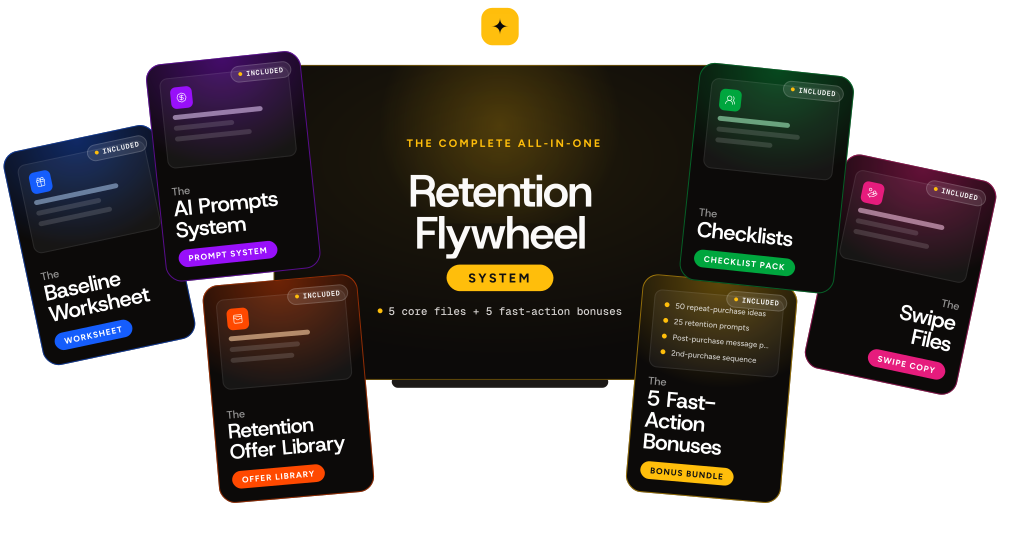
Five core files to find the leak, score fourteen levers, choose one campaign, check the economics, and launch with prompts, checklists, and swipe assets already mapped.
For comparison
A retention audit from an ecommerce agency starts at $1,500 and takes two weeks.
This is the same diagnosis, run by you, in thirty minutes.
The core, 5 documents
5 leaks, 14 levers, 9 prompts, 7 worksheets, 15 incentive types, 10 journey moments, 29 subject line patterns, 13 anti-patterns, 3 checklists.
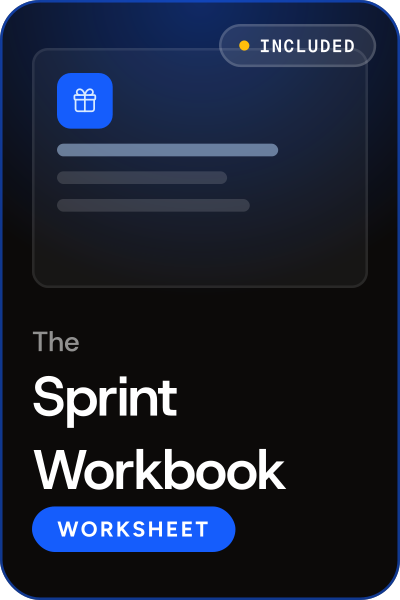
Baseline, leak finder, lever selector, campaign builder, scorecard, 30-day map
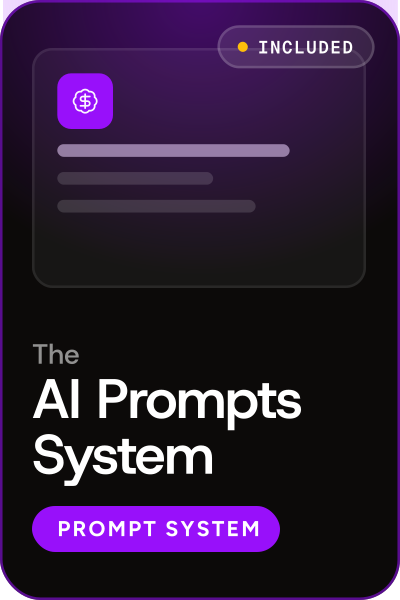
Nine prompts, run in order, in one conversation
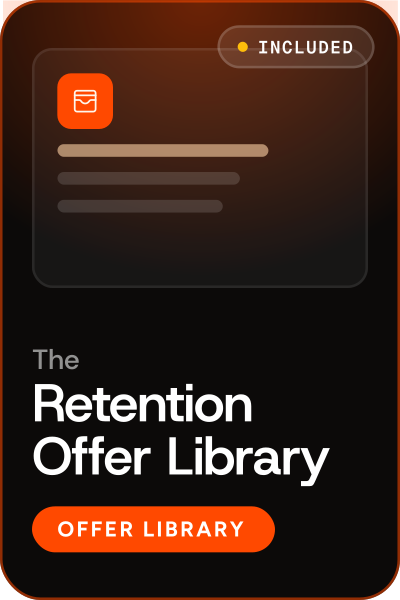
Every incentive ranked by what it actually costs you
Readiness, the ten journey moments, pre-launch QA
Subject lines, packaging inserts, and the patterns that reliably fail
Plus 5 bonuses, free
50 campaign ideas organised by leak, 25 further prompts, 8 post-purchase message templates, 12 metric formulas, and one complete win-back sequence.
Organised by the leak they address
Beyond the core nine
The messages between order one and order two
The most commonly botched sequence in ecommerce
Every formula, and how each one misleads
This is version 1.0. We are pricing it low while we gather feedback from the first merchants who run it. As the examples, implementation assets, and buyer proof improve, the price steps up toward $49.
Who this is not for
Stating this plainly costs us a few sales and saves you a wasted afternoon.
Fewer than roughly 100 orders. Patterns below that are noise
One-time high-ticket products with no accessories or repeat need
Marketplace-only sellers with no control of customer communication
Unresolved product quality or fulfilment problems. Fix those first
Anyone hoping retention tactics will fix broken unit economics
If that is you, do not buy this. It will not help yet.
FAQs
Most questions come down to the same thing: this is not another tool to install. It is a decision system for what to run next.
This does not replace your email tool. It decides what behavior each flow should cause, for which segment, and at what moment.
A loyalty app is infrastructure. This defines the economics, triggers, and offers that infrastructure should execute. Fair warning: we also publish the cases where a loyalty platform is the wrong first move.
Then replenishment is not your lever. Adjacency, bundles, education, occasion, and gifting are. The lever library covers all of them.
There is a low-data path built for exactly that. It uses product logic and five customer reviews instead of cohort analysis.
Because the model will give you a listicle. The diagnostic sequence, leak taxonomy, scoring rubric, and economic guardrails are the product. The model applies them to your store.
Reasonable question. Retention Flywheel is published by the team behind Perkli, a Shopify loyalty platform. The diagnostic is platform-neutral: it names a behavior to change, never a product to buy. Where a lever needs infrastructure, we show free and built-in options alongside paid ones, including ours. A diagnostic that steers is not a diagnostic.
Who made this
Retention Flywheel is published by the team behind Perkli, a Shopify-native loyalty and rewards platform.
We say that up front because you would find out anyway, and because it is the reason to trust the diagnostic rather than a reason to doubt it. We look at retention data across merchant stores. That is where this method came from.